
THE MEDITERRANEAN
THEME
Cuttlefish, Camargue Bull, Emulsified Garlic & Olive Oil Sauce
The approach to this dish is based on the subtle harmony of its ingredients. The bull meat, traditionally slow-cooked, is reinterpreted here: we prepare it as a tournedos and apply a quick compression technique in order to preserve the intensity of its meat. The cuttlefish, meanwhile, is sliced into thin strips and scale-like flakes to bring lightness to the palate.
Sea lettuce brings relief to the dish with its natural salinity, while olive oil acts as the connecting thread that binds the elements together and fixes the aromas. We deliberately move away from traditional cooking methods to emphasize the interplay of contrasting textures and a more
contemporary approach to the product.

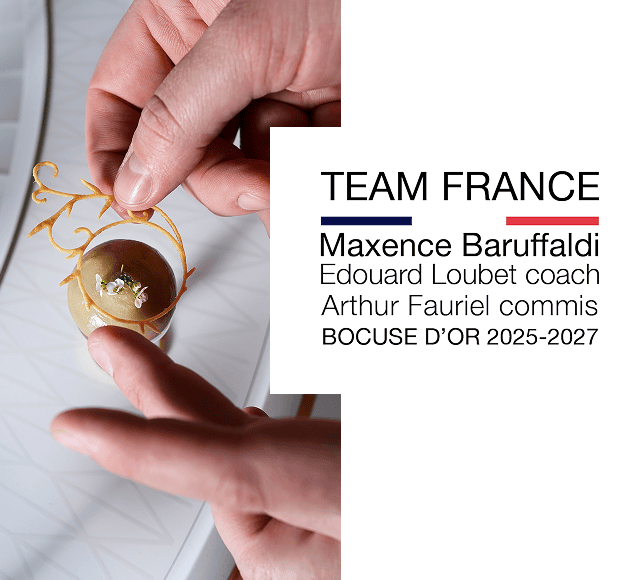
Cuttlefish Scales
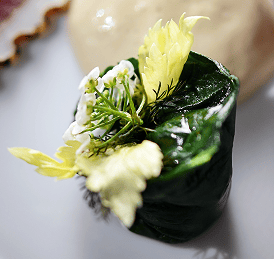
The scales are grilled to achieve a Maillard reaction. This cooking method adds depth to the cuttlefish and enhances its indulgent flavor.
In the spirit of a plant-based Barbajuan
The barbajuan filling brings a great deal of softness thanks to the brocciu cheese, while the blend of herbs adds a note of freshness and balance to this plant-based preparation.
Cuttlefish-Larded Tournedos
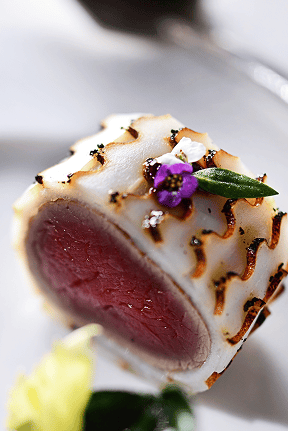
The tournedos, a great classic of French cuisine, highlights technical mastery and precision in cooking; the traditional fat is replaced by a coating of cuttlefish scales, bringing tension and a light briny note.
Bull and Cuttlefish Charcuterie
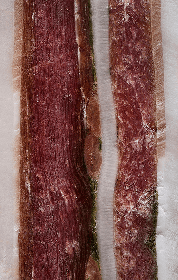
The main feature of this charcuterie lies in the work on its texture. It is a new approach that has been specifically designed for this year’s theme.
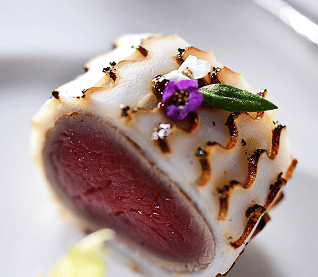
Cuttlefish-Larded Tournedos
The tournedos, a great classic of French cuisine, highlights technical mastery and precision in cooking; the traditional fat is replaced by a coating of cuttlefish scales, bringing tension and a light briny note.
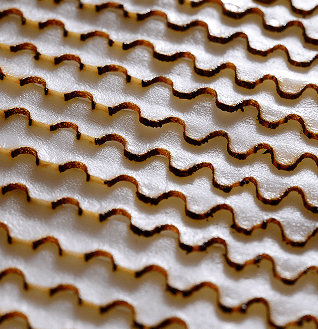
Cuttlefish Scales
The scales are grilled to achieve a Maillard reaction. This cooking method adds depth to the cuttlefish and enhances its indulgent flavor.
Bull and Cuttlefish Charcuterie
The main feature of this charcuterie lies in the work on its texture. It is a new approach that has been specifically designed for this year’s theme.
In the spirit of a plant-based Barbajuan
The barbajuan filling brings a great deal of softness thanks to the brocciu cheese, while the blend of herbs adds a note of freshness and balance to this plant-based preparation.
Cuttlefish-Larded Tournedos
The tournedos, a great classic of French cuisine, highlights technical mastery and precision in cooking; the traditional fat is replaced by a coating of cuttlefish scales, bringing tension and a light briny note.
Bull and Cuttlefish Charcuterie
The main feature of this charcuterie lies in the work on its texture. It is a new approach that has been specifically designed for this year’s theme.
Cuttlefish Scales
The scales are grilled to achieve a Maillard reaction. This cooking method adds depth to the cuttlefish and enhances its indulgent flavor.
In the spirit of a plant-based Barbajuan
The barbajuan filling brings a great deal of softness thanks to the brocciu cheese, while the blend of herbs adds a note of freshness and balance to this plant-based preparation.

THE PLATTER
THEME
Chickpea, Purple Artichoke, Sea Urchin, Red Mullet
The Mediterranean gastronomy theme resonates particularly strongly with Maxence Baruffaldi, who is originally from Toulon. The products and recipes of this region—such as cade, anchoïade, and pistou—shaped his childhood.
It is therefore natural that the French candidate chose to select the best of this terroir to create a platter rooted in tradition and rich in cultural references. The red mullet is prepared in the style of a bouillabaisse, while the artichoke is cooked à la barigoule.

THE PLATTER
Chickpea, Purple Artichoke, Sea Urchin, Red Mullet
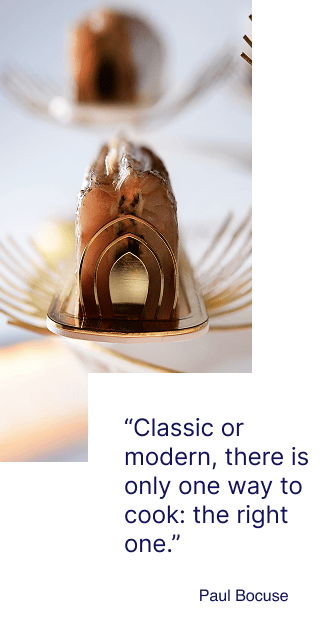
Each element is designed in reference to an iconic Provençal location or echoing its natural form. The stuffed red mullet is presented as if swimming in a school, true to its wild state, and framed by golden fins that recreate its natural lines.
The shape of the platter references the Palais Longchamp in Marseille; like its columns, each preparation is arranged in a linear sequence.
The chickpea appears in an oval shape, a motif frequently found in southern France, both in architecture and in pastries such as the calisson. The lighting of the platter evokes the play of light observed when fishing or swimming in shallow waters along the beaches of Provence.
THE PLATTER
Chickpea, Purple Artichoke, Sea Urchin, Red Mullet
The Mediterranean gastronomy theme resonates particularly strongly with Maxence Baruffaldi, who is originally from Toulon. The products and recipes of this region—such as cade, anchoïade, and pistou—shaped his childhood.
It is therefore natural that the French candidate chose to select the best of this terroir to create a
platter rooted in tradition and rich in cultural references. The red mullet is prepared in the style of a
bouillabaisse, while the artichoke is cooked à la barigoule.
THE PLATTER
Chickpea, Purple Artichoke, Sea Urchin, Red Mullet
The design of the platter itself references Provençal traditions; the central part represents a girellier, a fishing tool used near the calanques. Traditionally made from wicker, girelliers are woven in a crisscross pattern. It is this basketwork that Team France has chosen to incorporate into the various elements of the platter, reinforcing the connection to the sea.
The filigree grid on the lower part of the platter is inspired by the Mucem building designed by Rudy Ricciotti.
THE PLATTER
Chickpea, Purple Artichoke, Sea Urchin, Red Mullet
Each element is designed in reference to an iconic Provençal location or echoing its natural form. The stuffed red mullet is presented as if swimming in a school, true to its wild state, and framed by golden fins that recreate its natural lines.
The shape of the platter references the Palais Longchamp in Marseille; like its columns, each
preparation is arranged in a linear sequence.
The chickpea appears in an oval shape, a motif frequently found in southern France, both in architecture and in pastries such as the calisson. The lighting of the platter evokes the play of light observed when fishing or swimming in shallow waters along the beaches of Provence.
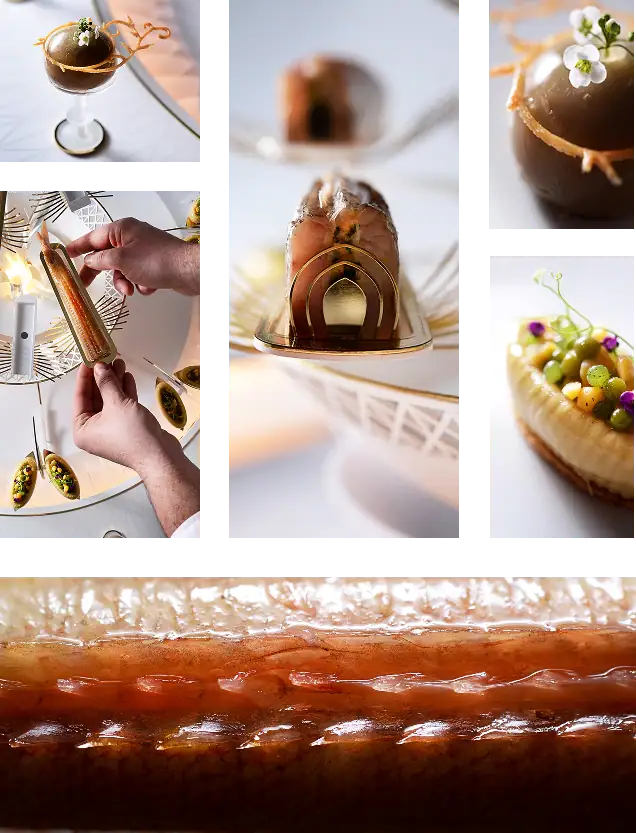

Sea Urchin
The sea urchin sauce is a tomato velouté finished with olive oil. The tomato coats the sea urchin,
bringing both sweetness and a lingering finish on the palate.
Artichoke à la Barigoule
In this preparation, the artichoke serves both as the filling and the vessel; its form is a tribute to
traditional craftsmanship, and it is shaped using a wood lathe.
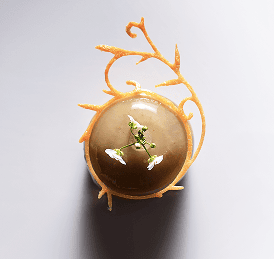
Stuffed Red Mullet
The red mullet is cooked whole to retain the moisture of the flesh, while the herby filling adds
tenderness.


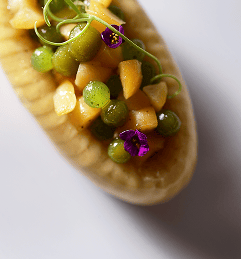
Chickpea
The grooves of the “navette” (a traditional biscuit) recall the texture of Provençal stones. The navettes
are always presented in pairs, like chickpea pods on the plant.
Artichoke à la Barigoule
In this preparation, the artichoke serves both as the filling and the vessel; its form is a tribute to traditional craftsmanship, and it is shaped using a wood lathe.
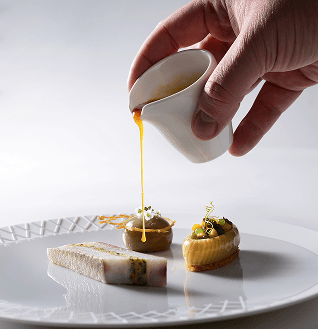
Sea Urchin
The sea urchin sauce is a tomato velouté finished with olive oil. The tomato coats the sea urchin, bringing both sweetness and a lingering finish on the palate.
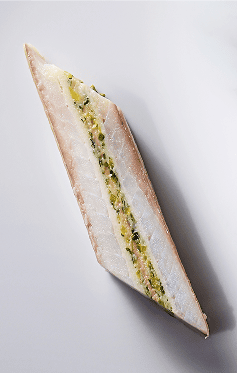
Stuffed Red Mullet
The red mullet is cooked whole to retain the moisture of the flesh, while the herby filling adds tenderness.
Chickpea
The grooves of the “navette” (a traditional biscuit) recall the texture of Provençal stones. The navettes are always presented in pairs, like chickpea pods on the plant.